
Celebrating One Year Since the Launch of Trailblazing

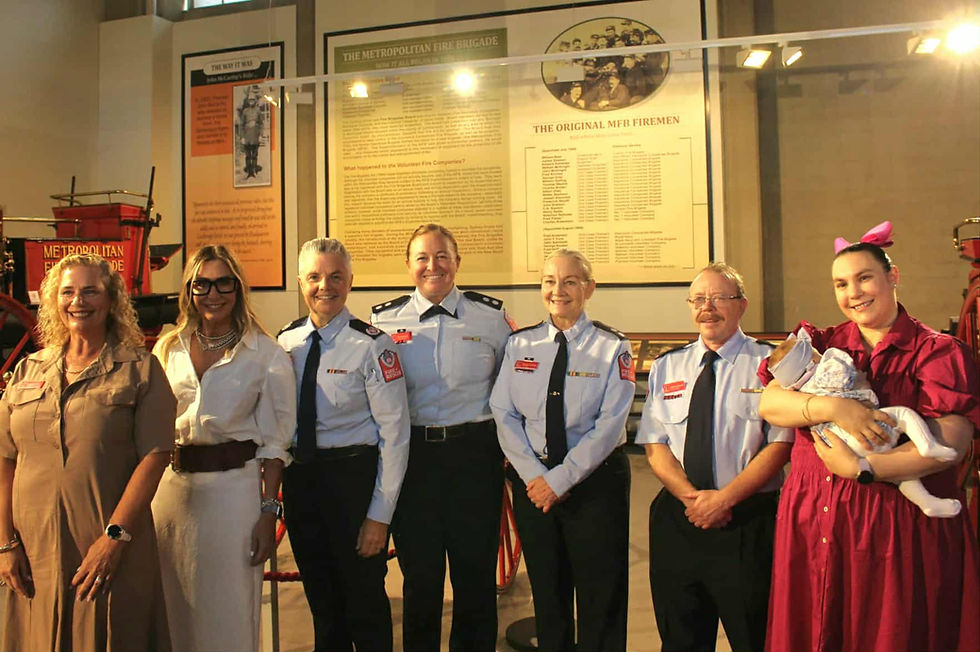
In 2020, Assistant Commissioner Cheryl Steer set out to record the history of female firefighters in Fire and Rescue NSW. The culmination of her vision was the launch of the book “Trailblazing: The History and Stories of Female Firefighters in Fire and Rescue NSW (FRNSW)”.
This book details not only how these women came to join the organisation, their challenges, contributions and stories, but also the experiences of many other women who were 'firsts' - whether that be by date of commencement, achievement, or cultural influence.
Last year, 2025, marked forty years since women were permitted to join the NSW Fire Brigades (today known as FRNSW). To celebrate this milestone the Museum hosted the launch of this special book in October 2025. Our CEO, Belinda McMartin, was one of the authors of this book and one year on, we take a brief look at this important piece of firefighting history.
The information shared here is extracted from the book “Trailblazing: The History and Stories of Female Firefighters in Fire and Rescue NSW (FRNSW)” with permission of the Museum of Fire, the official heritage partner to FRNSW. To read the complete book please visit the Museum in store or online: https://www.museumoffire.net/product-page/trailblazing-the-history-of-female-firefighters-in-the-fire-and-rescue-nsw
Women have always had a role to play in the fire protection of New South Wales (NSW). In many instances, it was the women who ‘manned’ the phone and sounded the alarm to alert the Brigade to emergencies. The reason for this was that, especially in remote and regional NSW, the men would be away from home (or the fire station) attending their place of work, so their wives and daughters were tasked with being on hand to take any emergency calls. These women would then sound the alarm, which would notify the men that they were required to jump to action.
Despite this widespread action by women historically within FRNSW, whenever the topic of women in the NSW Fire Brigades is mentioned, the first thing most people will tell you is that the Armidale Amazons were the first all-female fire brigade.
While this isn’t entirely true, it is an interesting piece of history and one worth including in the annals of women’s firefighting history in NSW. Established in 1902, the Armidale Amazons were an incredibly well-trained brigade of young women; however, literature at the time of the NSW Brigade’s existence confirms they were established as a ‘novelty performance group’. The Brigade gained notoriety for the skill of the young girls, especially as it was the only one of its type in Australia, and the fact they performed the same drills as the men, but in dresses, only gained them more publicity.
The first time that women were formally introduced to the history of FRNSW was during World War II when women were called to action to support the war effort. A leading body in this undertaking was the Women’s Australian National Services (WANS), which oversaw the training of women in various fields, such as ambulance drivers and motor appliance mechanics. The Women’s Fire Auxiliary (WFA) was established as a division of WANS but under the auspice of the NSWFB in response to the mounting possibility of a Japanese attack.
These women were being trained much the same as Probationary Firefighters of the time. Though, while Probationary Firefighters did most of their training ‘on the job’ in comparison the women were undertaking crash courses in a more formalised manner as a wartime measure to ensure they would be ready to assist the national crisis, should the need arise. As a direct result of the success of this program that was extended across NSW, after the war, all new recruit firefighters entered a formalised training program, similar to that undertaken by the women. Thus, women were in fact the first to experience a formal training program within the history of FRNSW.
Following WWII, until 1985 women played little role other than administrative in the operations history of FRNSW. That all changed in 1982 when Dr Kristine Klugman became the first woman to be appointed to the NSWFB’s Board of Fire Commissioners (the governing body of the NSWFB). This coincided with a changing political tide that resulted in the implementation of the NSW Sex Discrimination Act of 1984 (Cth), which enabled women to be employed in the same roles as men and receive equal pay. The year 1984 was also the centenary of the NSWFB.
This legal change was reflected in 1985 within the NSWFB when the opportunity to be employed as a firefighter was opened to women.
The changes to the Fire Brigades Act were only made possible thanks to the work of Dr. Kristine Klugman, who was the only female representative appointed to the Board of Fire Commissioners of NSW. Aged 41 and a mother of three teenage girls, she undertook and passed the physical test given to newly recruited firefighters, thus proving that women were capable and owed the same opportunities as men to become firefighters and should be open to all genders.

Through the publication of the book, “Trailblazing: The History and Stories of Female Firefighters in Fire and Rescue NSW (FRNSW)”, the stories of the women who paved the way for today’s female firefighters have been able to be shared. From a lack of amenities for women at fire stations to attitudes of the men whose ranks they joined, the first women to join the NSWFB were indeed trail blazers, and their stories of perseverance and leadership are told in the pages of this wonderful book.
~Story by Museum of Fire Heritage Team


Comments